We spent the next two years running it. Megha across paid, SEO, ABM and CRO. Kyle owning paid media across India, North America, Europe and Latin America. Both of us carrying numbers that ran past MQLs into opportunities and pipeline, which meant that when a quarter went sideways there was nowhere useful to hide.
Two years of that taught us something we have not managed to unlearn since.
Paid media rarely fails in the ads account
It usually fails in the gaps around it.
The landing page nobody got around to updating. The sales handoff that dropped the context the ad had just spent money creating. The creative that took three weeks. The product data that never made it back into the platform, so the bidding kept optimising toward something we did not actually want.
The account is rarely where a campaign broke. It is where you find out it already did.
That reads as obvious on a page. It is much less obvious in the room, when someone is asking why cost per lead moved and the quickest available answer is a bid strategy or a match type. We have given that answer ourselves. Occasionally it was even the right one. More often it was the easiest thing to say about a problem that actually belonged to four different teams, none of whom were in the meeting.
Working out which of those two situations you are in is most of the job. It is also the part that is hard to explain in a pitch, which is partly why we would rather write it down.
Then we left, and kept calling each other anyway
Megha moved on first. Kyle followed later.
Different companies after that, at different stages, with different problems — a cybersecurity company, a developer skills platform, a bootstrapped product team where one of us was the first full-time marketing hire in the building.
And we kept reaching out to each other.
Not formally, and not as a plan. Just the specific, slightly annoying question you only ask someone whose judgement you have already tested.
Have you seen this before. Would you cut this or fix it. Is this budget defensible. Am I wrong about this.
Several years and several jobs later, neither of us had stopped.
The joke had a good run
We talked about doing this properly long before we said it seriously. It was a running joke first — the kind you make at the end of a call where you have just spent forty minutes on someone else’s problem for free.
Eventually it stopped being funny and started sounding reasonable.
Acquret is what happened when we admitted the arrangement had been working for years and mostly needed a name.
What we can’t tell you yet
We are a few months old.
So we do not have a wall of client logos, and we are not going to build a case study deck out of a small sample and present it as proof. You have sat through those decks. So have we, from the buying side.
What we have instead is a fairly long run of doing this work inside companies where the numbers were ours to defend. That is what we are writing from. It is a genuinely different thing from results we can attribute to Acquret, and we would rather say so than blur the two. When we have those, we will publish them.
We are also, honestly, still working out what this company should be. The work we know. The agency is new.
What the name means
Acquire and retain, accurately.
The business leans toward acquisition, because that is what most companies at this stage are chasing and it is where we have spent most of our careers. But the second half is not decoration.
A pattern we keep running into: an email programme that only ever talks to prospects and never to customers. A product release existing users never hear about. An upsell path that exists in the product and nowhere in the marketing.
None of those are big projects. They are usually just nobody’s job. We try to notice them.
Who this is for
B2B SaaS companies, roughly $1M to $50M in revenue, Series A through E.
Concretely: companies around the stage CleverTap and HackerRank were at when we worked there, and plenty of companies well below it. What they tend to have in common is needing someone properly hands-on, or senior support they are not ready to hire full-time for — often both at once, which is an awkward combination to recruit for and a straightforward one to bring in.
Between us we have run campaigns across North America, EMEA, APAC and Latin America, in more than one vertical. We are not going to claim every category and every market is equally familiar. But the shape of the problem travels better than people expect, and where it does not, we would rather tell you early.
What we own, and what we don’t
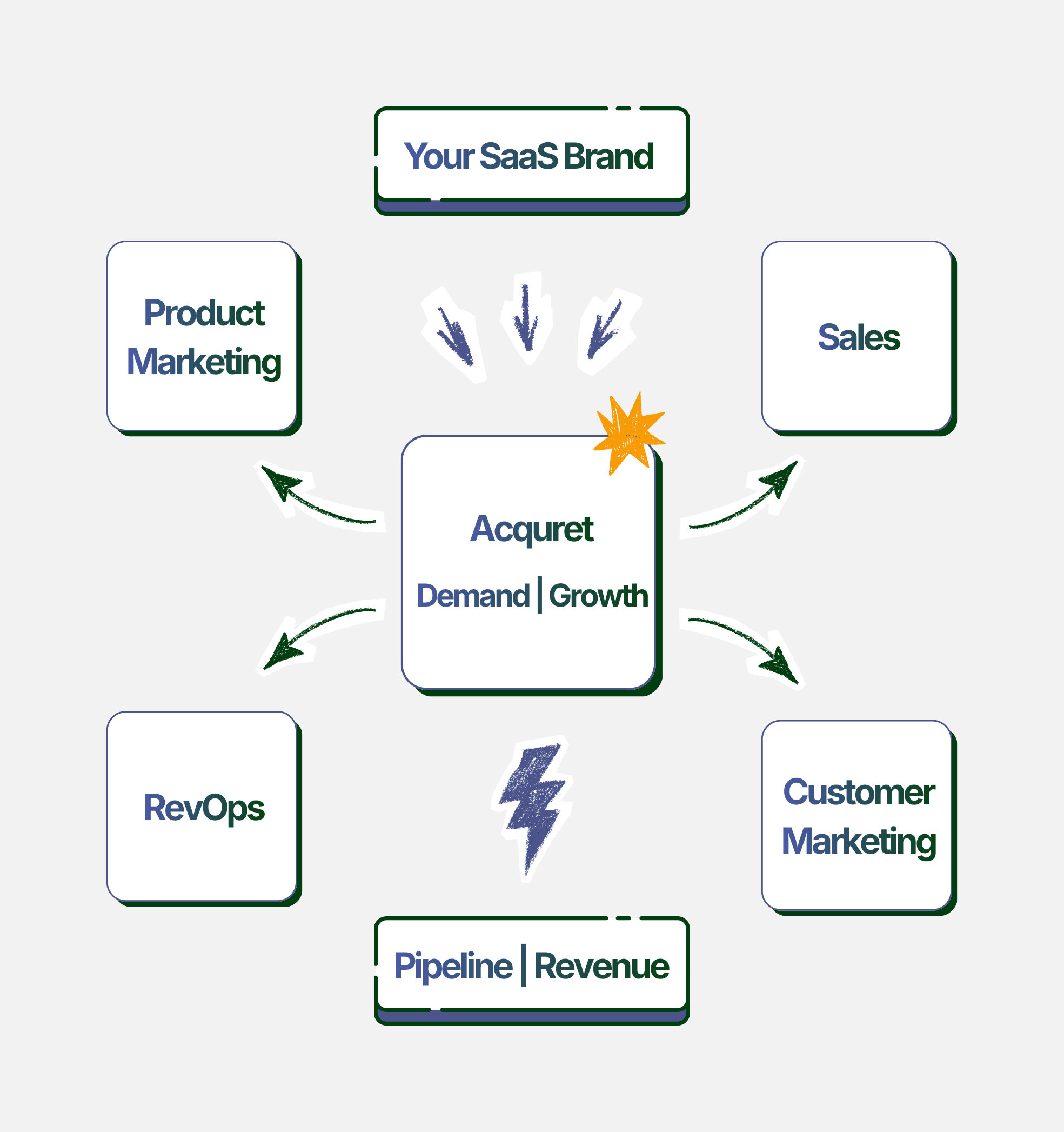
We own paid media end to end. Strategy, execution, optimisation, and the structural work around it — landing pages, creative direction, the tooling that moves information between your product, your CRM and your ad platforms, the sales-side updates that decide whether a lead goes anywhere. If it determines whether the spend works, we treat it as in scope.
On organic and content we work strategically. We set direction and work with your developers, tech teams and designers to get it shipped. We are not a production shop.
We do not do product marketing. If you have someone doing it, we want to work closely with them, because their positioning largely decides whether our campaigns land. It is not a job we are going to claim.
We are also probably not the right fit if what you need is someone to take a budget, run ads against it, and send a report on Friday. That is a real service and plenty of teams need exactly that — but we would end up pushing on things outside the brief, which is a frustrating way for both sides to work.
Both of us started hands-on at agencies, then spent years on the client side briefing and managing them. Seeing that relationship from both ends gave us a reasonable sense of where it tends to quietly stop working. Avoiding those failure modes is most of what we are trying to do here, and we will find out over the next couple of years how well we manage it.
What we’re publishing here
Two pieces to start, both about the same shift in how buyers find software.
The first is on answer engine optimisation and why it’s so hard to fund — buyers now research inside LLMs constantly, almost none of it reaches your analytics, and in B2B a channel you cannot measure is a channel that struggles to survive a budget review.
The second is on why your B2B CPCs are rising when your bidding has not changed, and where the evidence for the first piece has been sitting all along.
Six years on, we are still calling each other about other people’s marketing problems. The main difference is that it is the job now.
Megha Vishnoi and Kyle D’souza have spent 21 years between them in B2B SaaS marketing at CleverTap, HackerRank, PingSafe, Cin7 Orderhive and Food Label Maker, and agency-side at Performics, GroupM and iProspect. If you’re between $1M and $50M in revenue and working through something in demand gen, we’re happy to talk it through — no obligation to work together.
